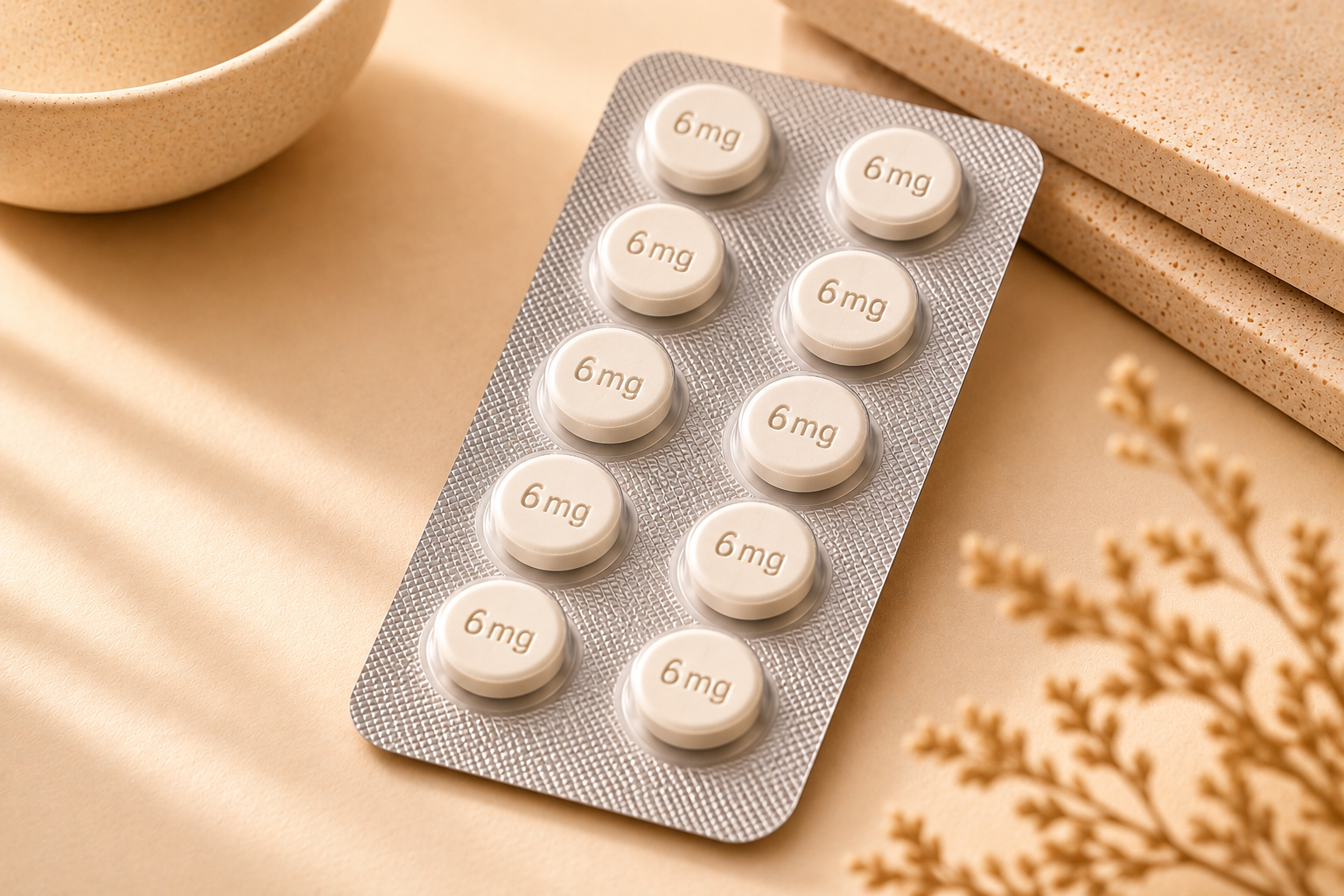
Ivermectin 6 mg tablets represent the higher standard oral strength of ivermectin used in systemic antiparasitic therapy. This dosage form is commonly selected for weight‑based regimens requiring fewer tablets per dose, while maintaining the same pharmacologic activity as lower strengths. Ivermectin 6 mg is available in both generic formulations and as part of the branded Stromectol line, offering identical active ingredient performance with brand‑specific manufacturing standards.
The 6 mg strength is widely used for scabies, strongyloidiasis, and resistant lice infestations, providing efficient dosing for adult patients. Compared with the 3 mg strength, ivermectin 6 mg reduces pill burden while delivering equivalent therapeutic outcomes. Explore related sections: Ivermectin oral, Stromectol, Ivermectin 3 mg.
Ivermectin 6 mg is an oral tablet strength of systemic ivermectin designed to simplify dose construction in antiparasitic therapy. It contains the same active ingredient as all oral ivermectin formulations, including the 3 mg strength and the branded product Stromectol 6 mg. The 6 mg tablet does not alter the drug’s pharmacodynamics or therapeutic effect; instead, it provides a higher‑strength unit that reduces the total number of tablets required in informational weight‑based regimens.
The definition of the 6 mg dosage is structural: it represents a doubled tablet strength compared with the standard 3 mg unit. This allows clinicians and guideline authors to describe systemic regimens using fewer tablets, improving convenience in scenarios where higher total amounts are referenced. This description is informational only and does not constitute dosing advice.
The role of the 6 mg tablet in informational schemes is to streamline administration, especially in infections requiring larger systemic totals—such as strongyloidiasis, crusted scabies, or high‑burden parasitic infestations. Because the 6 mg strength halves the tablet count compared with 3 mg, it is often preferred in higher‑weight categories or protocols emphasizing simplicity.
Compared with Ivermectin 3 mg, the 6 mg tablet offers convenience but less flexibility. The 3 mg strength allows fine‑tuned mg/kg construction, while the 6 mg strength reduces complexity. Both are fully interchangeable and deliver identical systemic activity. Ivermectin 6 mg is available as both generic ivermectin and Stromectol 6 mg, with differences limited to branding, excipients, and price.
| Parameter | Value |
|---|---|
| Strength | 6 mg oral tablet |
| Role in regimens | Reduces tablet count in informational systemic schemes |
| Difference vs 3 mg | Same effect; 6 mg offers convenience, 3 mg offers precision |
| Generic vs brand | Available as generics and as Stromectol 6 mg |
| Use cases | Higher‑weight categories; simplified informational regimens |
Ivermectin 6 mg is supplied as a solid oral tablet, designed to deliver systemic antiparasitic activity with the same pharmacological profile as the 3 mg strength. The 6 mg tablet is typically film‑coated, compact, and optimized for stable dissolution in the gastrointestinal tract. Its higher strength allows for simplified tablet counts in informational weight‑based regimens, especially in scenarios requiring larger systemic totals.
The formulation includes standard excipients such as microcrystalline cellulose, pre‑gelatinized starch, magnesium stearate, and film‑coating agents. These inactive components support tablet stability, uniformity, and absorption but do not alter ivermectin’s mechanism of action or systemic distribution. Differences in excipients between manufacturers are commercial rather than therapeutic.
Ivermectin 6 mg tablets are commonly packaged in blister strips or boxed units, providing moisture protection and long‑term stability. Packaging formats may vary by region, but the dosage strength and tablet characteristics remain standardized across generic and branded products.
The 6 mg strength is produced by several generic manufacturers, while Stromectol 6 mg represents the originator brand. Both versions contain the same active ingredient and deliver identical systemic efficacy, differing only in branding, excipients, and pricing.
| Parameter | Value |
|---|---|
| Dosage form | Oral tablet, film‑coated |
| Excipients | Cellulose, starch derivatives, magnesium stearate, coating agents |
| Packaging | Blister packs or boxed units |
| Manufacturers | Multiple generics; originator brand Stromectol 6 mg |
Ivermectin 6 mg acts through the same well‑established antiparasitic mechanism as all oral ivermectin formulations. Its activity is based on selective binding to glutamate‑gated chloride channels located in the nerve and muscle cells of invertebrates. When ivermectin attaches to these channels, it increases chloride ion influx, causing cellular hyperpolarization. Humans do not possess glutamate‑gated chloride channels, which explains ivermectin’s strong selectivity and favorable safety margin. A broader mechanistic overview is available on Ivermectin MOA.
This hyperpolarization leads to paralysis of parasites, preventing them from feeding, attaching, or reproducing. In nematodes and ectoparasites, the paralysis is irreversible, ultimately resulting in death. The 6 mg strength does not alter the mechanism itself; it simply provides a higher‑strength tablet that reduces the number of units needed in systemic regimens.
As an oral systemic formulation, ivermectin distributes through the bloodstream and peripheral tissues, reaching parasites located beyond the skin surface. This systemic reach is essential for infections such as strongyloidiasis, crusted scabies, and resistant lice. The MOA of the 6 mg tablet is identical to that of the 3 mg strength, generic ivermectin, and Stromectol 6 mg — the difference lies only in tablet strength and convenience, not pharmacodynamics.
The pharmacokinetic profile of Ivermectin 6 mg is identical to that of the 3 mg strength, as both contain the same active ingredient and differ only in tablet size. The 6 mg tablet is used primarily for convenience in informational systemic regimens, but its absorption, distribution, metabolism, and elimination follow the same well‑characterized pathways. A full overview of ivermectin PK is available at Ivermectin PK.
Absorption. After oral administration, ivermectin is absorbed in the gastrointestinal tract, with baseline bioavailability influenced by individual variability and the drug’s intrinsic lipophilicity. Effect of high‑fat meals. Co‑administration with fatty food significantly increases systemic exposure by enhancing dissolution and absorption. This effect applies equally to 3 mg and 6 mg tablets.
Distribution. Ivermectin is highly lipophilic and strongly protein‑bound, enabling extensive distribution into peripheral tissues. This systemic reach is essential for infections involving circulating larvae or deep‑tissue parasite reservoirs.
Metabolism. The drug undergoes hepatic biotransformation primarily via CYP3A4, with minor contributions from other oxidative pathways. The 6 mg strength does not alter metabolic behavior, as the active ingredient and excipient profile remain consistent with other oral formulations.
Elimination. Ivermectin is excreted mainly through the biliary–fecal route, with minimal renal clearance. Its prolonged elimination half‑life reflects strong tissue binding and supports interval‑based systemic regimens described in clinical references.
| Parameter | Value |
|---|---|
| Absorption | Enhanced with high‑fat meals; variable baseline bioavailability |
| Distribution | Highly lipophilic; extensive tissue penetration; strong protein binding |
| Metabolism | Primarily via CYP3A4; oxidative hepatic pathways |
| Elimination | Biliary–fecal excretion; long elimination half‑life |
Ivermectin 6 mg is an oral antiparasitic tablet used in the same clinical contexts as all systemic ivermectin formulations. Its therapeutic indications fully overlap with the 3 mg strength, as both contain the same active ingredient and deliver identical systemic activity. The difference lies in tablet strength and convenience, not pharmacodynamics. Expanded clinical overviews are available on Ivermectin for scabies, Ivermectin for strongyloides, and Ivermectin for lice.
Scabies. Ivermectin 6 mg is used in systemic therapy for classic, crusted, and treatment‑resistant scabies. Its systemic distribution allows it to reach mites and larvae located beyond the epidermis, making it useful when topical therapy is insufficient or impractical.
Strongyloidiasis. Ivermectin is the reference standard for Strongyloides stercoralis, a systemic nematode infection requiring deep‑tissue penetration. The 6 mg strength is often preferred in informational regimens requiring higher systemic totals, as it reduces the number of tablets needed.
Lice. Oral ivermectin is used for resistant or recurrent lice infestations, particularly when topical agents fail. Systemic exposure ensures coverage even when parasites are difficult to reach or when adherence to topical therapy is limited.
Although ivermectin 3 mg and 6 mg are therapeutically identical, the 6 mg strength offers significant advantages in convenience. It is especially useful in informational weight‑based regimens requiring larger systemic totals, where halving the tablet count improves practicality.
Dosing convenience. The 6 mg tablet reduces the number of units required in higher‑weight categories or in infections where systemic totals are larger. This simplifies administration and improves adherence.
Scenarios where 6 mg is preferred. The 6 mg strength is advantageous in severe scabies, strongyloidiasis, and high‑burden parasitic infections, where informational regimens reference higher systemic amounts. Fewer tablets reduce complexity without altering efficacy.
Situations requiring fewer tablets. In clinical frameworks emphasizing simplicity, the 6 mg strength is preferred because it minimizes tablet load while maintaining identical pharmacologic action.
| Parameter | 6 mg | 3 mg |
|---|---|---|
| Use in scabies | Fewer tablets; convenient for severe cases | Flexible combinations; precision‑focused |
| Use in strongyloidiasis | Preferred for higher systemic totals | Useful for fine‑tuned mg/kg construction |
| Use in lice | Convenient for adults and higher‑weight groups | Convenient for lower‑weight categories |
| Convenience | Maximum simplicity; fewer tablets | Maximum precision; more tablets |
The following section provides an informational overview of how Ivermectin 6 mg is described in clinical literature and guideline‑style sources. These patterns are not individualized recommendations; they illustrate how systemic regimens are typically structured using the 6 mg tablet strength. Because the 6 mg unit halves the tablet count compared with 3 mg, it is often used in informational schemes requiring larger systemic totals.
In reference materials, ivermectin is commonly described in single‑dose and two‑dose interval‑based patterns. These schemes aim to cover different stages of parasite development. The 6 mg strength is frequently used in higher‑weight categories or scenarios where simplified tablet counts improve practicality. The pharmacologic effect remains identical to the 3 mg strength; only the number of tablets differs.
Informational protocols may include repeat courses for persistent infestations, high environmental exposure, or infections with autoinfection cycles. Repeat intervals are structured to align with parasite maturation timelines. The 6 mg tablet is advantageous in these scenarios because it reduces the total number of tablets required for each systemic course, improving convenience without altering systemic exposure.
In infections associated with high parasite load, informational sources describe the potential for stronger inflammatory responses due to rapid parasite death. Some references outline staged or interval‑based systemic patterns to moderate clearance intensity. These considerations apply to all ivermectin strengths, but the 6 mg tablet is often preferred when higher systemic totals are referenced, as it minimizes tablet load while maintaining identical pharmacodynamics.
| Pattern | Description |
|---|---|
| Single‑dose schemes | Used in many antiparasitic protocols; fewer tablets due to 6 mg strength |
| Two‑dose interval schemes | Second informational dose after a defined interval for life‑cycle coverage |
| Repeat courses | Structured repeats for persistent or high‑exposure infections |
| High‑burden protocols | Staged or interval‑based informational patterns for heavy parasite loads |
The safety considerations for Ivermectin 6 mg fully mirror those of all oral ivermectin formulations, including the 3 mg strength and branded Stromectol. Contraindications arise from ivermectin’s pharmacology rather than tablet size. A broader overview is available at Ivermectin oral — precautions.
Ivermectin 6 mg is generally avoided in individuals with hypersensitivity to ivermectin or other macrocyclic lactones. Because ivermectin undergoes hepatic metabolism, significant liver impairment may increase systemic exposure. Conditions associated with compromised blood–brain barrier integrity may elevate the risk of central nervous system penetration. These considerations apply equally to generic ivermectin and Stromectol.
Certain groups require additional caution due to altered pharmacokinetics or increased susceptibility to adverse reactions. These include frail older adults, individuals with severe systemic illness, and those with hepatic dysfunction. In endemic regions, people with high Loa loa microfilarial loads may experience Mazzotti‑type inflammatory reactions due to rapid parasite death. Pregnancy and breastfeeding require careful evaluation because systemic exposure may affect fetal or neonatal development.
Ivermectin is metabolized primarily by CYP3A4 and transported by P‑glycoprotein (P‑gp). Strong CYP3A4 inhibitors (azole antifungals, macrolides, antiretrovirals) may increase systemic exposure, while inducers may reduce it. P‑gp inhibitors can increase tissue penetration, including potential CNS exposure. These interactions are mechanistic and apply equally to the 6 mg and 3 mg strengths.
| Category | Description |
|---|---|
| General contraindications | Hypersensitivity, severe hepatic impairment, compromised BBB |
| Special populations | Pregnancy, breastfeeding, frail adults, high Loa loa burden |
| Drug interactions | CYP3A4 inhibitors/inducers; P‑gp modulators |
The interaction profile of Ivermectin 6 mg is identical to that of the 3 mg strength and all other oral ivermectin formulations. Interactions arise from ivermectin’s CYP3A4‑dependent metabolism, P‑glycoprotein (P‑gp) transport, and potential pharmacodynamic overlap with other antiparasitic agents. A broader overview is available on Ivermectin oral interactions.
Ivermectin is metabolized primarily by CYP3A4, making it sensitive to co‑administered modulators of this enzyme. • CYP3A4 inhibitors (azole antifungals, macrolides, antiretrovirals) may increase systemic exposure and prolong ivermectin’s presence in circulation. • CYP3A4 inducers may reduce systemic levels, potentially lowering antiparasitic activity. These effects apply equally to 6 mg and 3 mg tablets.
Ivermectin is a substrate of P‑gp, an efflux transporter that limits penetration into sensitive tissues, including the central nervous system. P‑gp inhibitors (certain calcium channel blockers, macrolides, immunosuppressants) may increase tissue distribution and raise the risk of neurological exposure. Combined CYP3A4 and P‑gp inhibition can amplify systemic levels.
Although ivermectin does not have a direct pharmacokinetic interaction with alcohol, concurrent use may intensify overlapping effects such as dizziness, fatigue, or gastrointestinal discomfort. Alcohol may also indirectly influence hepatic metabolism, which is relevant given ivermectin’s CYP3A4 dependence.
Ivermectin is sometimes used alongside albendazole or mebendazole in informational combination protocols. These combinations may increase the likelihood of additive gastrointestinal or systemic reactions. Such interactions are pharmacodynamic rather than metabolic and apply equally to all ivermectin strengths.
| Interaction Type | Description |
|---|---|
| CYP3A4 inhibitors | Increase systemic exposure; may intensify pharmacologic effects |
| P‑gp modulators | Alter tissue distribution; may increase CNS penetration |
| Anthelmintics | Potential additive effects in combination protocols |
| Alcohol | May enhance overlapping side effects; informational caution |
The adverse‑effect profile of Ivermectin 6 mg is fully identical to that of the 3 mg strength, as both contain the same active ingredient and differ only in tablet size. Most reactions described in clinical literature are mild, transient, and related either to ivermectin’s pharmacologic activity or to the body’s immune response during parasite clearance. A broader overview is available on Ivermectin general safety.
Frequently reported reactions include dizziness, headache, fatigue, nausea, abdominal discomfort, and diarrhea. Mild dermatologic symptoms such as itching or rash may also occur. These effects are typically short‑lived and often reflect inflammatory responses to dying parasites rather than direct drug toxicity. The 6 mg strength does not increase the likelihood of these reactions; it simply reduces the number of tablets required.
Less common events include hypotension, tachycardia, confusion, ataxia, or other neurological symptoms. These reactions are more likely in individuals with impaired blood–brain barrier function or significant hepatic dysfunction, which may increase systemic exposure. Such events are rare and apply equally to generic ivermectin and Stromectol 6 mg.
In infections with high parasite burden, individuals may experience Mazzotti‑type reactions triggered by the immune response to rapid parasite death. These may include fever, lymph node swelling, joint pain, intense itching, or inflammatory skin changes. These reactions are mechanistic and occur with all oral ivermectin strengths, including 6 mg and 3 mg.
| Category | Description |
|---|---|
| Common effects | Dizziness, headache, nausea, abdominal discomfort, mild rash |
| Rare effects | Hypotension, tachycardia, neurological symptoms in susceptible individuals |
| Mazzotti‑type reactions | Fever, lymphadenopathy, pruritus, inflammatory response to parasite death |
Ivermectin 6 mg and Ivermectin 3 mg contain the same active ingredient and provide identical systemic antiparasitic activity. The difference lies exclusively in tablet strength, which affects convenience, dosing construction, commercial positioning, and availability. A broader overview of the lower‑strength formulation is available on Ivermectin 3 mg.
The 6 mg tablet is designed to reduce the total number of tablets required in informational systemic regimens. This is especially useful in higher‑weight categories or infections where reference materials describe larger systemic totals. The 3 mg tablet, by contrast, offers maximum flexibility for fine‑tuned mg/kg construction, making it suitable for precise weight‑based calculations or lower‑weight groups.
Both strengths are used in the same parasitic infections—scabies, strongyloidiasis, and resistant lice. The 6 mg strength is often preferred in informational frameworks for severe scabies, crusted scabies, or strongyloidiasis, where simplified tablet counts improve practicality. The 3 mg strength is more commonly referenced in guidelines due to its historical status as the standard unit and its precision in constructing weight‑based schemes.
Ivermectin 3 mg is typically the cheapest strength because it is produced by the largest number of generic manufacturers. Ivermectin 6 mg may carry a slight premium due to fewer producers and its convenience‑focused positioning. Branded Stromectol versions of both strengths are more expensive than generics.
The 3 mg strength has the broadest global distribution and is widely stocked in pharmacies. The 6 mg strength is increasingly available but remains less common in some markets, though demand is rising due to its simplified tablet count.
| Parameter | 6 mg | 3 mg |
|---|---|---|
| Dosing convenience | Fewer tablets; simplified administration | Maximum precision; flexible mg/kg construction |
| Clinical scenarios | Preferred in high‑burden or severe infections | Common in standard guideline references |
| Cost | Slightly higher; fewer manufacturers | Lower; widely available generics |
| Availability | Growing but less universal | Global distribution; most common strength |
Ivermectin 6 mg (generic) and Stromectol 6 mg (brand‑name) contain the same active ingredient and deliver identical systemic antiparasitic activity. The distinction lies in branding, excipient consistency, regulatory positioning, and commercial factors—not in pharmacodynamics. Stromectol is the originator brand and is often referenced in clinical literature, while generic ivermectin is produced by multiple manufacturers. More details on the branded formulation are available on Stromectol.
Stromectol 6 mg represents the reference brand‑name formulation, manufactured with a standardized excipient profile and consistent quality controls. Generic ivermectin 6 mg is produced by various manufacturers worldwide, resulting in differences in inactive ingredients and packaging. Despite these variations, therapeutic efficacy, systemic exposure, and mechanism of action remain identical, and generics are considered fully interchangeable with Stromectol.
Both Stromectol and generic ivermectin demonstrate equivalent oral bioavailability, governed by ivermectin’s lipophilicity, CYP3A4 metabolism, and enhanced absorption with high‑fat meals. Minor excipient differences do not meaningfully affect systemic exposure. Clinical PK studies consistently show no significant difference between brand and generic 6 mg formulations.
The most notable distinction is price. Stromectol typically carries a brand‑name premium, making it significantly more expensive than generic ivermectin 6 mg. Generics benefit from competitive manufacturing and broader distribution, resulting in lower cost and wider availability. Pricing details for the branded product are available at Stromectol price.
| Parameter | Generic Ivermectin 6 mg | Stromectol 6 mg |
|---|---|---|
| Brand status | Multiple manufacturers; generic formulation | Originator brand; single manufacturer |
| Bioavailability | Equivalent systemic exposure | Equivalent systemic exposure |
| Cost | Lower; widely available | Higher; brand‑name premium |
| Availability | Broad global distribution | More limited; varies by region |
Ivermectin 6 mg occupies a convenience‑focused position in the ivermectin product range. Although it contains the same active ingredient as the 3 mg strength, its higher tablet potency influences pricing, availability, and commercial distribution. The 6 mg tablet is produced by fewer manufacturers, which often results in a slightly higher retail cost. A broader overview of market pricing is available on Ivermectin price.
The 6 mg tablet is generally priced above the 3 mg strength on a per‑tablet basis and sometimes even on a per‑milligram basis. This is due to more limited production, smaller manufacturer pools, and its positioning as a convenience‑oriented formulation. Despite the higher unit price, the 6 mg strength may reduce the total number of tablets required in informational systemic regimens, which can partially offset cost differences in practical use.
Ivermectin 3 mg remains the lowest‑cost and most widely available strength, benefiting from extensive generic production. The 6 mg strength, while more expensive, offers simplified tablet counts and is often preferred in informational frameworks requiring higher systemic totals. Commercially, 3 mg dominates global distribution, while 6 mg is expanding but still less common in some regions.
Pricing for ivermectin 6 mg varies based on manufacturer, regional regulations, import policies, supply chain stability, and brand vs generic status. Branded Stromectol 6 mg typically carries a premium, while generics offer more competitive pricing. Market fluctuations and global demand also influence retail cost.
| Parameter | Value |
|---|---|
| Typical 6 mg price | Higher than 3 mg; fewer manufacturers |
| Comparison with 3 mg | 6 mg carries a convenience premium; 3 mg is lowest‑cost |
| Cost factors | Manufacturer, region, regulations, supply chain, brand status |