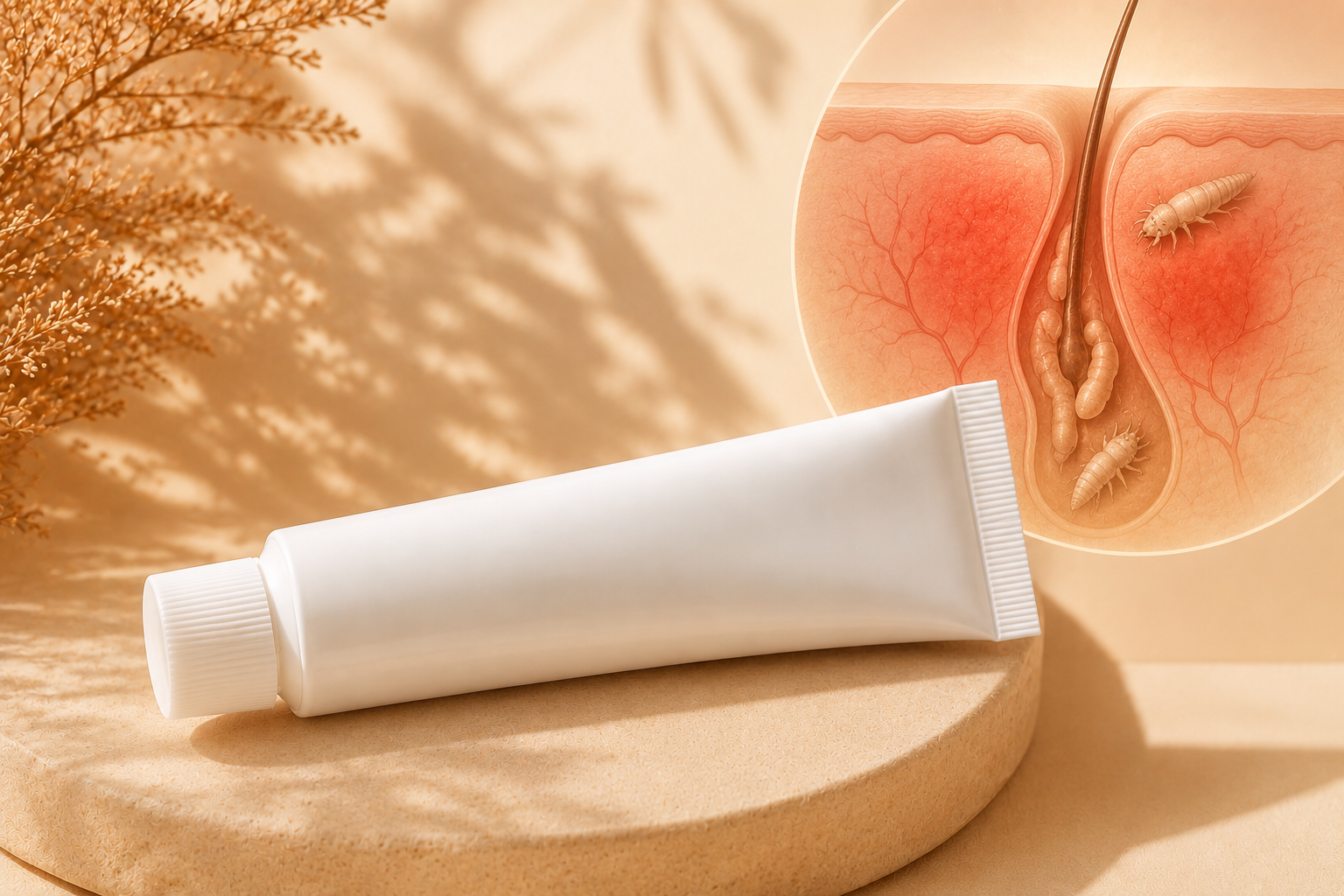
Soolantra Cream 1% is a branded topical formulation of ivermectin designed specifically for papulopustular rosacea. It combines two complementary mechanisms: anti-inflammatory activity that helps calm redness and irritation, and targeted anti-Demodex action that reduces mite density, which may contribute to rosacea flare patterns. This dual approach makes Soolantra a widely used option for individuals seeking steady improvement in inflammatory lesions and overall skin comfort.
Compared with generic ivermectin cream 1%, Soolantra features a proprietary cream base that may differ in texture, spreadability, and tolerability. Many users also compare Soolantra with metronidazole and azelaic acid, two other common rosacea treatments with different mechanisms and clinical profiles. This guide explains how Soolantra fits into rosacea-focused care and how it compares with alternative topical options. Explore related sections: Soolantra cream, Ivermectin for rosacea, Soolantra vs Ivermectin.
Rosacea is a chronic inflammatory skin disorder that primarily affects the central face — cheeks, nose, chin, and forehead. It is characterized by persistent redness, visible blood vessels, papules, pustules, and episodes of flushing. The condition follows a long‑term, relapsing course and varies widely in severity. Although the exact cause remains multifactorial, rosacea is strongly associated with dysregulated inflammation, vascular hyperreactivity, and increased sensitivity of the skin barrier.
Rosacea is clinically divided into several subtypes, each with distinct features:
Inflammation is central to rosacea pathogenesis. Patients exhibit heightened innate immune responses, increased expression of inflammatory cytokines (IL‑8, TNF‑α), and overactivation of TLR‑2 pathways. This leads to persistent erythema, swelling, and sensitivity. Vascular instability contributes to flushing and visible blood vessels, while chronic inflammation drives papulopustular lesions.
Demodex folliculorum mites are found in higher density on rosacea‑affected skin. Their presence can trigger immune activation, barrier disruption, and inflammatory cascades. In many patients, Demodex overgrowth is a key driver of papulopustular rosacea, making anti‑Demodex therapies such as Soolantra (ivermectin 1%) particularly effective.
| Parameter | Description |
|---|---|
| Definition | Chronic inflammatory facial skin disorder |
| Subtypes | ETR, PPR, phymatous, ocular |
| Inflammation | Key driver of erythema and lesions |
| Demodex role | Increased mite density triggers inflammation |
Soolantra (ivermectin 1% cream) is one of the leading topical therapies for papulopustular rosacea due to its dual‑action mechanism targeting both inflammation and Demodex overgrowth. These two factors are central to rosacea pathophysiology, especially in patients with recurrent inflammatory flares. A detailed mechanistic overview is available at Ivermectin MOA.
Many rosacea patients exhibit elevated densities of Demodex folliculorum. Their presence triggers immune activation and inflammatory cascades. Ivermectin binds to glutamate‑gated chloride channels in mites, causing paralysis and death. This direct anti‑mite effect reduces a major inflammatory trigger and is a key reason Soolantra outperforms other topicals in Demodex‑associated rosacea.
Ivermectin suppresses inflammatory mediators such as IL‑8, TNF‑α, and TLR‑2 pathways. This reduces erythema, swelling, and sensitivity. The anti‑inflammatory effect complements the anti‑Demodex action, producing a broader therapeutic impact.
Clinical trials consistently show rapid improvement in papules and pustules — often within 2–4 weeks. This makes Soolantra particularly effective for moderate papulopustular rosacea and for patients who have not responded well to metronidazole or azelaic acid.
Soolantra’s emollient vehicle supports barrier repair, reduces dryness, and improves overall skin comfort. This is especially important for rosacea patients with reactive, sensitive skin.
Soolantra’s mechanism of action combines anti‑mite, anti‑inflammatory, and barrier‑supportive effects. These mechanisms work synergistically to reduce inflammatory lesions, erythema, and skin sensitivity.
Ivermectin paralyzes and eliminates Demodex mites by binding to chloride channels. This reduces mite density and prevents further immune activation. Since Demodex overgrowth is strongly associated with papulopustular rosacea, this mechanism is central to Soolantra’s effectiveness.
Ivermectin downregulates key inflammatory mediators, including IL‑8, TNF‑α, and TLR‑2. This decreases redness, swelling, and sensitivity. The reduction of cytokine activity also contributes to improved skin texture and fewer inflammatory lesions.
By targeting both mites and inflammation, Soolantra reduces papules, pustules, and background erythema. Improvement is typically visible within 2–4 weeks, faster than many other topical therapies.
Topical ivermectin acts locally within the epidermis and follicles, providing high efficacy with minimal systemic absorption. Oral ivermectin, while effective for severe Demodex infestation, is not routinely used for rosacea due to systemic exposure and lack of long‑term data.
| MOA element | Description |
|---|---|
| Anti‑Demodex | Direct mite elimination via chloride channel binding |
| Cytokine reduction | Suppresses IL‑8, TNF‑α, TLR‑2 pathways |
| Lesion improvement | Rapid reduction of papules and pustules |
| Topical vs oral | Local action with minimal systemic absorption |
Soolantra (ivermectin 1% cream) has one of the strongest clinical evidence portfolios among topical rosacea treatments. Multiple randomized controlled trials (RCTs), including large Galderma‑sponsored studies, demonstrate its efficacy in reducing inflammatory lesions, improving skin quality, and maintaining long‑term remission. These trials consistently show that ivermectin’s dual anti‑Demodex and anti‑inflammatory activity provides superior outcomes for papulopustular rosacea compared to vehicle and several alternative topicals.
Across pivotal RCTs, Soolantra achieved significantly higher Investigator Global Assessment (IGA) success rates than vehicle. Patients experienced:
Ivermectin’s anti‑Demodex activity directly reduces a key inflammatory trigger. Combined with cytokine suppression (IL‑8, TNF‑α), this results in substantial lesion reduction. In most studies, Soolantra outperformed metronidazole and azelaic acid in papulopustular lesion clearance.
The emollient vehicle enhances hydration, reduces dryness, and improves barrier function. Patients frequently report smoother texture, reduced sensitivity, and improved overall skin comfort.
Long‑term extension studies show that Soolantra maintains remission with continued use and reduces recurrence frequency. Its dual mechanism provides sustained control of both inflammation and Demodex‑related triggers.
| Parameter | Outcome |
|---|---|
| Lesion reduction | Strong; visible in 2–4 weeks |
| Skin quality | Improved hydration and texture |
| Long‑term effect | Maintains remission; reduces recurrence |
| Clinical evidence | Multiple RCTs; strong comparative data |
Soolantra and generic ivermectin cream 1% share the same active ingredient, but differ significantly in formulation quality, tolerability, clinical validation, and cosmetic elegance. These differences influence patient comfort, adherence, and overall treatment outcomes. A detailed comparison is available at Soolantra vs Ivermectin.
Soolantra uses a premium dermatology‑optimized emollient base designed for sensitive, rosacea‑prone skin. It includes stabilizers, moisturizers, and a vehicle engineered for minimal irritation. Generic ivermectin creams typically use simpler cream bases with variable excipients and less refined texture.
Soolantra demonstrates consistently high tolerability in clinical trials, with very low rates of burning, stinging, or dryness. Generic formulations may cause dryness or mild irritation depending on the manufacturer and excipient profile.
Soolantra has extensive RCT‑level evidence supporting its efficacy in papulopustular and Demodex‑associated rosacea. Generic ivermectin creams rely on molecule‑level evidence rather than formulation‑specific trials, meaning their clinical performance may vary.
Soolantra’s soft, hydrating, elegant texture spreads easily and supports barrier repair. Generic creams may feel heavier, less smooth, or more drying, depending on formulation quality.
| Parameter | Soolantra | Generic ivermectin |
|---|---|---|
| Formulation | Premium emollient base | Standard cream base |
| Tolerability | Very high | Variable |
| Clinical evidence | Extensive RCTs | Limited formulation‑specific data |
| Texture | Soft, elegant, hydrating | Varies; may be thick or drying |
Soolantra (ivermectin 1%) and metronidazole 0.75–1% are two of the most widely used topical therapies for papulopustular rosacea. Although both reduce inflammation, they differ fundamentally in mechanism, tolerability, speed of action, and clinical performance. A detailed comparison is available at Soolantra vs Metronidazole.
Soolantra provides dual anti‑Demodex + anti‑inflammatory activity, directly reducing mite density and suppressing cytokines (IL‑8, TNF‑α, TLR‑2). Metronidazole offers anti‑inflammatory + antimicrobial effects, reducing ROS and microbial load but without anti‑Demodex action.
Soolantra’s emollient base delivers excellent tolerability with minimal burning or dryness. Metronidazole is generally well tolerated, though gels may cause dryness or mild irritation.
RCTs show Soolantra achieves higher IGA success rates and faster lesion reduction than metronidazole. Metronidazole remains effective for erythema‑dominant rosacea but is less potent for papulopustular lesions.
Soolantra improves lesions within 2–4 weeks, while metronidazole typically requires 6–8 weeks for visible improvement.
| Parameter | Soolantra | Metronidazole |
|---|---|---|
| Mechanism | Anti‑Demodex + anti‑inflammatory | Anti‑inflammatory + antimicrobial |
| Tolerability | Very high | High; gels may dry |
| Clinical efficacy | Stronger lesion reduction | Moderate; strong for erythema |
| Speed of action | 2–4 weeks | 6–8 weeks |
Soolantra (ivermectin 1%) and azelaic acid 15–20% are both effective for rosacea but differ in efficacy, tolerability, and ideal skin‑type match. A detailed comparison is available at Soolantra vs Azelaic acid.
Soolantra provides the strongest reduction of papules and pustules, especially in Demodex‑associated rosacea. Azelaic acid reduces erythema and offers moderate lesion control, with added keratolytic benefits.
Soolantra’s emollient base ensures excellent tolerability with minimal irritation. Azelaic acid is significantly more irritating, often causing burning, tingling, and temporary redness.
Soolantra is preferred for papulopustular and Demodex‑associated rosacea. Azelaic acid is useful for erythema‑dominant rosacea and patients needing mild exfoliation.
| Parameter | Soolantra | Azelaic acid |
|---|---|---|
| Efficacy | Strongest lesion reduction | Moderate; strong for erythema |
| Tolerability | Very high | Low–moderate |
| Skin type | Sensitive, reactive | Oily, combination |
| Clinical scenarios | Papulopustular, Demodex‑associated | Erythema, mild exfoliation |
Demodex‑associated inflammation is one of the most significant and well‑documented contributors to papulopustular rosacea. Many patients with moderate or persistent rosacea exhibit elevated densities of Demodex folliculorum, which can trigger immune activation, barrier disruption, and chronic inflammatory cascades. Understanding this relationship explains why Soolantra (ivermectin 1% cream) is uniquely effective in this subgroup. More details are available at Ivermectin for demodex.
Demodex mites inhabit hair follicles and sebaceous units. When their density increases, they:
This creates a self‑sustaining inflammatory loop that is difficult to break without directly reducing mite density.
Soolantra provides direct anti‑Demodex activity, binding to glutamate‑gated chloride channels in mites and causing paralysis and death. This eliminates a primary inflammatory trigger. In addition, ivermectin’s anti‑inflammatory properties suppress cytokine activity, reducing redness, swelling, and lesion formation.
Unlike metronidazole or azelaic acid, Soolantra targets both the cause (Demodex) and the effect (inflammation). Other topicals reduce inflammation but do not address mite overgrowth, making them less effective in Demodex‑driven rosacea. Soolantra’s emollient base also provides superior tolerability for sensitive skin.
| Feature | Description |
|---|---|
| High mite density | Common in papulopustular rosacea |
| Inflammatory activation | Triggers IL‑8, TNF‑α, TLR‑2 pathways |
| Clinical signs | Papules, pustules, erythema, sensitivity |
| Best treatment | Anti‑Demodex agents such as Soolantra |
Soolantra (ivermectin 1% cream) is considered one of the most tolerable topical treatments for rosacea. Its safety profile is supported by multiple RCTs and long‑term extension studies. Unlike systemic ivermectin, the topical form acts locally within the epidermis and follicles, resulting in minimal systemic absorption. A detailed overview is available at Ivermectin topical — side effects.
Most adverse reactions are mild and transient. Commonly reported effects include:
These reactions typically resolve without discontinuation. The emollient vehicle significantly reduces irritation compared to other rosacea topicals.
Topical ivermectin demonstrates minimal systemic absorption, with plasma concentrations far below those associated with oral ivermectin. This eliminates systemic side effects, drug interactions, and concerns related to systemic exposure.
Oral ivermectin is used for parasitic infections and occasionally for severe Demodex infestation, but it carries systemic risks and is not recommended for routine rosacea management. Topical ivermectin acts locally, providing targeted anti‑Demodex and anti‑inflammatory effects without systemic involvement.
| Side effect | Description |
|---|---|
| Local irritation | Mild; transient redness or warmth |
| Dryness | Rare due to emollient base |
| Systemic effects | None; minimal absorption |
| Comparison to oral | Topical is safer; no systemic exposure |
Soolantra (ivermectin 1% cream) has an extremely low interaction potential because it is applied topically and demonstrates minimal systemic absorption. Plasma concentrations remain far below those associated with oral ivermectin, meaning that clinically relevant interactions are highly unlikely. A broader overview of systemic ivermectin interactions is available at Ivermectin oral interactions.
Topical ivermectin acts locally within the epidermis and pilosebaceous units. Only trace amounts enter systemic circulation, and these levels are insufficient to interact with hepatic enzymes or other medications. As a result, Soolantra is considered one of the safest rosacea treatments in terms of drug–drug interactions.
Oral ivermectin undergoes hepatic metabolism (CYP3A4) and may interact with other systemic medications. Topical ivermectin does not share these risks, as it bypasses systemic metabolism and remains confined to the skin.
| Interaction factor | Description |
|---|---|
| Systemic absorption | Minimal; no clinically relevant levels |
| Drug interactions | Very unlikely |
| Difference from oral | No CYP3A4 involvement; no systemic exposure |
The cost of Soolantra (ivermectin 1% cream) varies widely depending on region, pharmacy, and insurance coverage. As a branded dermatology‑grade product, Soolantra is positioned at the higher end of the rosacea treatment price spectrum. More detailed pricing information is available at Soolantra price and Ivermectin price.
Soolantra is typically more expensive than generic rosacea treatments due to:
Patients often choose Soolantra when tolerability, cosmetic elegance, and rapid lesion reduction are priorities.
Generic ivermectin 1% creams are significantly cheaper but vary in formulation quality. They lack the refined vehicle and clinical validation of Soolantra. While the active ingredient is identical, differences in excipients can affect:
The price of Soolantra is influenced by:
| Price factor | Description |
|---|---|
| Brand cost | High; premium dermatology product |
| Generic comparison | Generics cheaper but less refined |
| Vehicle quality | Advanced emollient base increases cost |
| Clinical evidence | Extensive RCTs contribute to pricing |