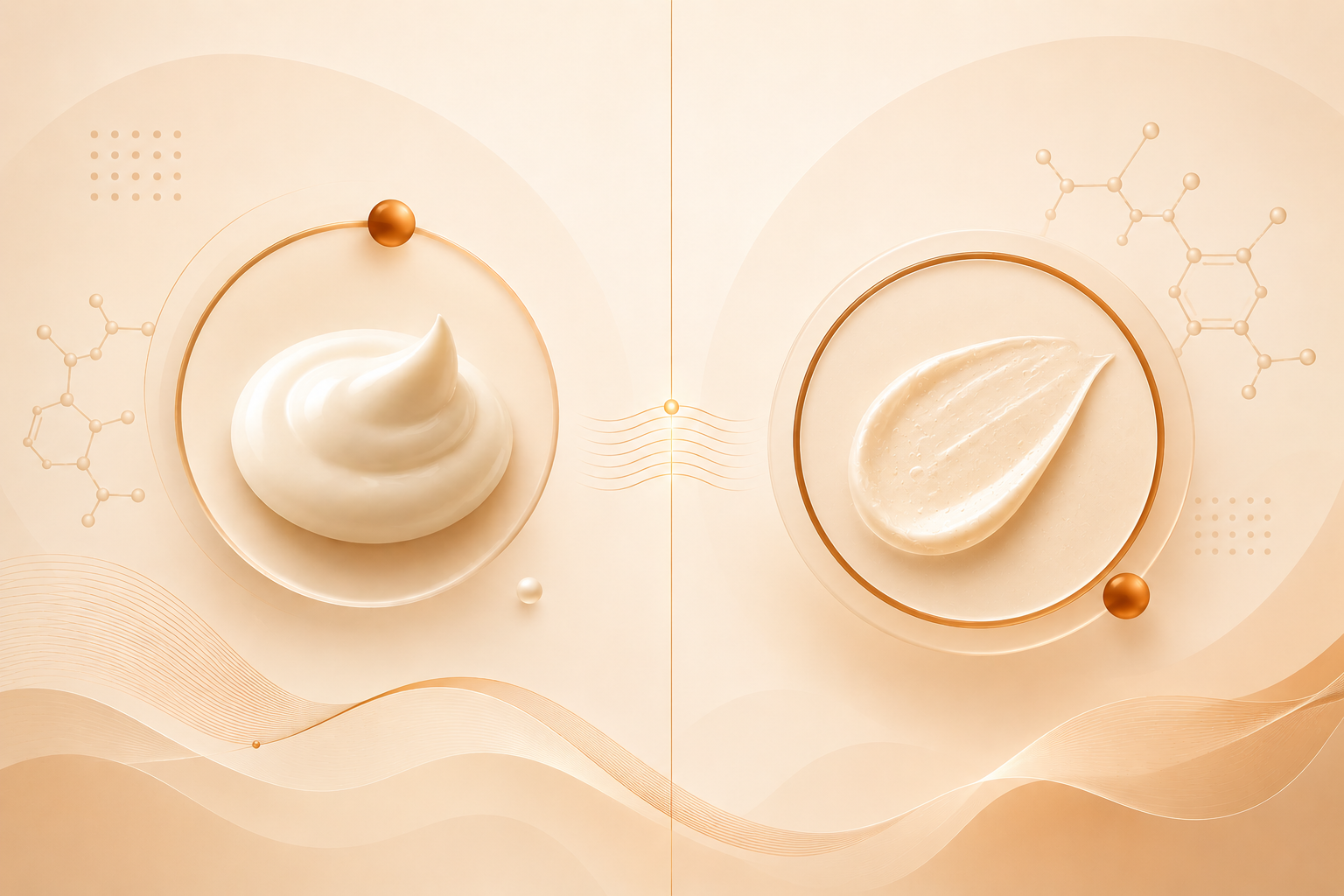
Soolantra (ivermectin 1%) and azelaic acid 15–20% are two widely used topical therapies for papulopustular rosacea. While both help reduce redness and inflammatory lesions, they work through distinct mechanisms. Soolantra combines anti-inflammatory activity with targeted anti-Demodex effects, which may benefit individuals whose rosacea is associated with mite overgrowth. Azelaic acid offers anti-inflammatory and keratolytic properties, helping unclog pores, smooth texture, and reduce persistent redness.
Key differences include mechanism of action, tolerability, texture, speed of visible improvement, and the type of clinical evidence supporting each treatment. Soolantra is often noted for its soothing cream base and dual-action profile, while azelaic acid is valued for its exfoliating effect and long-standing dermatologic use. This guide provides a structured, evidence-focused comparison to help users understand how each option fits into rosacea and Demodex-related care. Explore related sections: Soolantra cream, Ivermectin vs Azelaic acid, Ivermectin for rosacea.
Soolantra (ivermectin 1% cream) and azelaic acid 15–20% are two of the most commonly compared topical therapies for papulopustular rosacea. Both reduce inflammation and improve skin texture, yet they differ significantly in active ingredients, formulation types, mechanisms of action, and clinical scenarios where each performs best. These distinctions are essential for understanding when ivermectin‑based therapy is advantageous and when azelaic acid may be more appropriate.
Soolantra contains ivermectin 1%, which provides dual anti‑Demodex and anti‑inflammatory activity. Azelaic acid formulations contain 15% (gel/foam) or 20% (cream) concentrations, offering anti‑inflammatory, keratolytic, and pigment‑modulating effects. Both reduce inflammatory lesions, but ivermectin additionally targets Demodex mites, a key factor in many rosacea cases.
Soolantra is available exclusively as a soft, emollient cream optimized for sensitive and rosacea‑prone skin. Azelaic acid is available in gels, creams, and foams, with gels and foams often being more drying and creams more tolerable.
This makes Soolantra particularly effective in Demodex‑associated rosacea, while azelaic acid is useful when keratolytic or pigment‑modulating benefits are desired.
Soolantra is preferred for papulopustular rosacea, sensitive skin, and Demodex‑driven flares. Azelaic acid is often chosen for oily or combination skin, persistent erythema, or when mild exfoliation is beneficial.
| Parameter | Soolantra | Azelaic acid |
|---|---|---|
| Active ingredient | Ivermectin 1% | Azelaic acid 15–20% |
| Formulations | Emollient cream | Creams, gels, foams |
| Mechanism | Anti‑Demodex + anti‑inflammatory | Keratolytic + anti‑inflammatory |
| Clinical scenarios | Demodex‑associated & sensitive skin | Oily skin, erythema, mild exfoliation |
Soolantra (ivermectin 1% cream) and azelaic acid 15–20% both treat inflammatory rosacea, but their mechanisms of action differ at every level — molecular targets, inflammatory pathways, and effects on Demodex and the skin barrier. These mechanistic distinctions explain why ivermectin often provides stronger lesion reduction, while azelaic acid offers broader dermatologic benefits such as keratolysis and pigment modulation. A detailed mechanistic overview is available in Ivermectin MOA.
Ivermectin delivers a dual‑action mechanism highly relevant for papulopustular and Demodex‑associated rosacea:
Azelaic acid acts through multi‑pathway dermatologic effects:
Unlike ivermectin, azelaic acid does not target Demodex mites, which may limit its effectiveness in mite‑driven rosacea.
| MOA factor | Soolantra | Azelaic acid |
|---|---|---|
| Anti‑Demodex | Yes; strong | No |
| Anti‑inflammatory | Strong | Strong |
| Keratolytic | No | Yes |
| Erythema reduction | Moderate | Strong |
| Microbiome impact | Minimal | Moderate |
Both Soolantra and azelaic acid demonstrate minimal systemic absorption, making them safe for long‑term use and suitable for sensitive skin. However, differences in vehicle composition and epidermal penetration influence tolerability, distribution, and user experience. More PK details are available at Ivermectin PK.
Both medications act locally within the epidermis and pilosebaceous units. Plasma concentrations remain negligible, eliminating systemic side effects and drug interactions.
Soolantra’s emollient base enhances uniform distribution of ivermectin across the stratum corneum and follicles, improving comfort and reducing irritation. Azelaic acid penetrates more superficially and may cause transient stinging due to its acidic nature.
Unlike oral ivermectin or systemic azelaic acid, topical forms act exclusively within the skin and bypass systemic metabolism.
| PK parameter | Soolantra | Azelaic acid |
|---|---|---|
| Systemic absorption | Minimal | Minimal |
| Epidermal distribution | Uniform; enhanced by emollients | Variable; depends on formulation |
| Vehicle impact | Hydrating, low irritation | Gel/foam may sting; cream moderate |
| Oral vs topical PK | Local only | Local only |
Soolantra (ivermectin 1% cream) and azelaic acid 15–20% are both widely used for papulopustular rosacea, yet their clinical efficacy profiles differ due to their mechanisms, formulation characteristics, and skin‑type suitability. These differences influence how quickly each therapy improves inflammatory lesions, erythema, and overall skin quality.
Soolantra demonstrates robust efficacy in multiple Galderma‑sponsored randomized controlled trials. Key findings include:
Patients with Demodex‑driven rosacea often experience faster and more pronounced improvement with Soolantra compared to other topical agents.
Azelaic acid is effective for inflammatory rosacea but tends to work more gradually. Its efficacy profile includes:
However, azelaic acid does not target Demodex mites, which may limit its effectiveness in mite‑associated rosacea.
| Parameter | Soolantra | Azelaic acid |
|---|---|---|
| Lesion reduction | Strong, rapid (2–4 weeks) | Moderate, slower (6–8 weeks) |
| Erythema improvement | Moderate | Strong |
| Demodex efficacy | High; direct anti‑mite action | None |
| Clinical evidence | Extensive RCTs | Strong but more irritation‑prone |
The onset of visible improvement is a major factor in rosacea management. Soolantra and azelaic acid differ significantly in how quickly they reduce lesions and erythema, largely due to their mechanisms and vehicle characteristics.
Soolantra typically provides visible improvement within 2–4 weeks. This rapid response is driven by:
Patients with Demodex‑associated rosacea often experience even faster improvement due to rapid mite density reduction.
Azelaic acid generally shows improvement over 6–8 weeks. Its anti‑inflammatory, keratolytic, and antioxidant effects work progressively, making it suitable for oily or combination skin but slower for papulopustular flares.
| Parameter | Soolantra | Azelaic acid |
|---|---|---|
| Onset of improvement | 2–4 weeks | 6–8 weeks |
| Mechanistic driver | Anti‑Demodex + anti‑inflammatory | Anti‑inflammatory + keratolytic |
| Best for | Moderate rosacea, Demodex‑associated cases | Oily/combination skin; erythema |
Soolantra (ivermectin 1% cream) and azelaic acid 15–20% are both effective for inflammatory rosacea, but their tolerability profiles differ dramatically. These differences stem from vehicle composition, acidity, and mechanism‑related effects. A broader overview of ivermectin tolerability is available at Ivermectin topical — side effects.
Soolantra is formulated with a premium emollient vehicle specifically designed for sensitive, rosacea‑prone skin. Its tolerability advantages include:
Most adverse reactions are mild and transient, such as slight redness during the first days of use. Overall, Soolantra is considered one of the most tolerable topical rosacea treatments.
Azelaic acid is effective but significantly more irritating, especially in the first weeks of therapy. Common reactions include:
These effects are related to the acidic nature of the molecule and its keratolytic activity. Cream formulations are gentler but still more irritating than Soolantra.
| Side effect | Soolantra | Azelaic acid |
|---|---|---|
| Burning/stinging | Rare; very mild | Common; often pronounced |
| Erythema | Low incidence | Frequent; temporary |
| Dryness/peeling | Minimal | Moderate; depends on formulation |
| Skin sensitivity | Low | Moderate–high |
Although both Soolantra and azelaic acid are used for inflammatory rosacea, their indication profiles differ due to mechanism, tolerability, and skin‑type suitability. Condition‑specific details are available at Ivermectin for rosacea, Ivermectin for demodex, Ivermectin for acne, Ivermectin for perioral dermatitis.
Soolantra is highly effective for papulopustular rosacea, especially when Demodex involvement is suspected. It provides rapid lesion reduction and excellent tolerability. Azelaic acid is effective for erythema and mild inflammatory lesions but is more irritating.
Soolantra directly targets Demodex mites, making it the preferred option for Demodex‑associated rosacea. Azelaic acid does not affect mites and is less effective in mite‑driven inflammation.
Soolantra may help reduce inflammatory acne lesions, especially when Demodex contributes. Azelaic acid is widely used for acne due to its keratolytic and antimicrobial effects, making it suitable for oily and combination skin.
Soolantra is increasingly used off‑label due to its gentle vehicle and anti‑inflammatory effect. Azelaic acid may help but is often too irritating for the sensitive perioral area.
| Condition | Soolantra | Azelaic acid |
|---|---|---|
| Rosacea | Strong efficacy; ideal for papulopustular & Demodex‑associated cases | Effective for erythema; moderate lesion control |
| Demodex infestation | High efficacy; direct anti‑mite action | Not effective |
| Acne (off‑label) | Useful for inflammatory lesions | Strong efficacy; keratolytic + antimicrobial |
| Perioral dermatitis (off‑label) | Gentle, suitable for sensitive skin | Often too irritating |
Soolantra (ivermectin 1%), azelaic acid 15–20%, and metronidazole 0.75–1% represent the three most widely used topical therapies for inflammatory rosacea. Although all reduce inflammation, their mechanisms, tolerability, and skin‑type suitability differ substantially. A detailed comparison of ivermectin and metronidazole is available at Ivermectin vs Metronidazole.
Soolantra provides dual anti‑Demodex and anti‑inflammatory activity, making it highly effective for papulopustular and Demodex‑associated rosacea. Azelaic acid offers keratolytic, anti‑inflammatory, and pigment‑modulating effects but is more irritating. Metronidazole provides anti‑inflammatory and antimicrobial action with excellent long‑term safety.
| Parameter | Soolantra | Azelaic acid | Metronidazole |
|---|---|---|---|
| Mechanism | Anti‑Demodex + anti‑inflammatory | Keratolytic + anti‑inflammatory | Anti‑inflammatory + antimicrobial |
| Efficacy | Strongest lesion reduction | Moderate; strong for erythema | Moderate; strong for erythema |
| Tolerability | Very high | Low–moderate | High |
| Best for skin type | Sensitive, reactive | Oily, acne‑prone | Normal, combination |
Soolantra and azelaic acid differ significantly in cost due to branding, formulation complexity, and availability of generics. More detailed pricing information is available at Soolantra price and Ivermectin price.
Soolantra is a premium Galderma product with a dermatology‑optimized emollient base and extensive RCT support. Its higher price reflects:
Azelaic acid exists in both branded and generic forms, leading to a broad cost spectrum:
Cost depends heavily on formulation type, brand, and concentration.
Soolantra’s price is driven by its premium vehicle and RCT‑backed efficacy. Azelaic acid’s cost varies based on formulation complexity (foam > gel > cream) and whether the product is branded or generic.
| Product | Price level | Notes |
|---|---|---|
| Soolantra | High | Premium vehicle; strong clinical evidence |
| Azelaic acid | Low–high | Generic creams cheap; branded foams expensive |
Soolantra (ivermectin 1%) and azelaic acid 15–20% are both effective for rosacea, but their strengths differ. Soolantra excels in papulopustular and Demodex‑associated rosacea, offering rapid improvement and excellent tolerability. Azelaic acid is better suited for oily or combination skin, erythema‑dominant rosacea, and cases where keratolytic benefits are desired.
Soolantra provides faster lesion reduction, superior comfort, and strong RCT support. Azelaic acid offers broader dermatologic benefits (keratolysis, pigment modulation) but is more irritating.
| Parameter | Soolantra | Azelaic acid |
|---|---|---|
| Mechanism | Anti‑Demodex + anti‑inflammatory | Keratolytic + anti‑inflammatory |
| Lesion reduction | Strong, fast | Moderate, gradual |
| Erythema improvement | Moderate | Strong |
| Tolerability | Very high | Low–moderate |
| Price | High | Low–high |
| Best for | Papulopustular & Demodex‑associated rosacea | Oily skin; erythema; mild exfoliation |