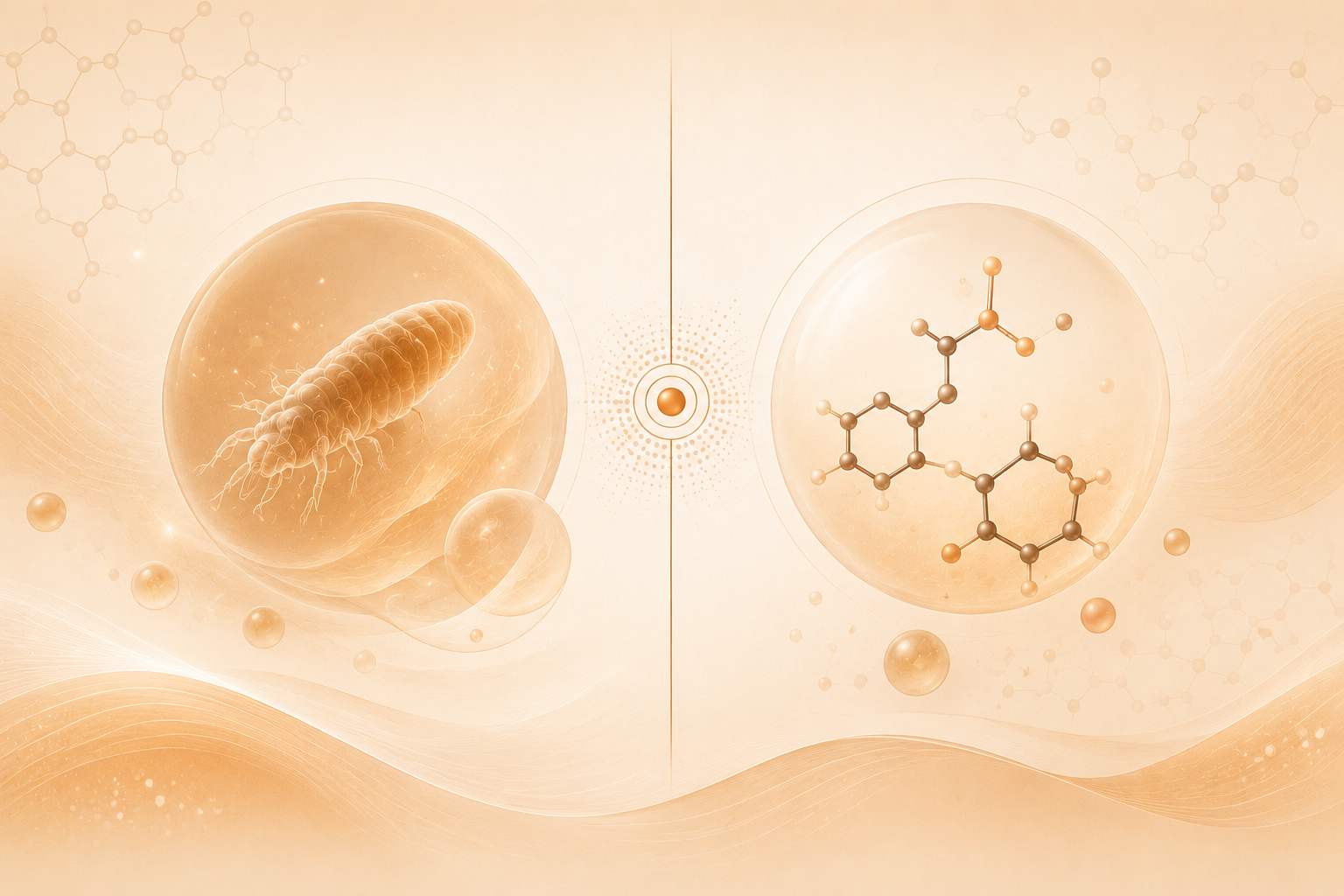
Ivermectin and benzyl benzoate are two antiparasitic agents frequently discussed in the context of scabies and Demodex‑related skin conditions, yet they belong to different pharmacologic categories and act through distinct mechanisms. Ivermectin provides targeted anti‑Demodex activity along with anti‑inflammatory effects, making it relevant in dermatology for conditions involving mite overgrowth. Topical ivermectin offers localized action with generally favorable tolerability, while oral formulations are used for systemic parasitic infections.
Benzyl benzoate, by contrast, acts through neurotoxic effects on mites and lice, leading to rapid immobilization. It is widely used for scabies due to its fast antiparasitic action, but may cause irritation in sensitive skin. Differences between the two agents include mechanism of action, tolerability, spectrum of activity, and clinical scenarios where each is most applicable. Explore related sections: Ivermectin topical, Ivermectin for Demodex, Ivermectin vs Permethrin.
Ivermectin and benzyl benzoate are two antiparasitic agents frequently discussed together in the context of scabies and Demodex‑associated skin conditions. Despite this thematic overlap, they differ substantially in their active substances, formulations, mechanisms of action, and clinical applications. Understanding these distinctions is essential for clarifying why ivermectin and benzyl benzoate are not interchangeable and why each occupies a specific therapeutic niche.
Ivermectin is a macrocyclic lactone that targets glutamate‑gated chloride channels in parasites, causing paralysis and death. Benzyl benzoate is an ester compound with direct neurotoxic effects on mites and lice, leading to rapid immobilization.
The formulation differences influence tolerability: ivermectin creams are dermatology‑optimized, while benzyl benzoate lotions may cause irritation, especially on sensitive skin.
These mechanistic differences explain why ivermectin is used for both parasitic and inflammatory dermatoses, while benzyl benzoate is primarily a scabicide.
Thus, while both agents target mites, ivermectin has broader dermatologic relevance due to its anti‑inflammatory profile.
| Parameter | Ivermectin | Benzyl Benzoate |
|---|---|---|
| Active substance | Macrocyclic lactone | Benzyl benzoate ester |
| Formulations | Creams, lotions, gels, oral tablets | Lotions, emulsions |
| Mechanism | Chloride‑channel modulation | Direct neurotoxicity to mites |
| Clinical scenarios | Scabies, Demodex rosacea, lice, nematodes | Scabies, lice |
The mechanisms of action of ivermectin and benzyl benzoate differ at every biological level, reflecting their distinct pharmacologic classes and therapeutic purposes. Ivermectin acts through selective neuro‑modulation in parasites, while benzyl benzoate exerts direct neurotoxic effects on mites and lice. These mechanistic differences explain why ivermectin is used for both parasitic and inflammatory dermatoses, whereas benzyl benzoate is primarily a scabicide. A detailed mechanistic overview of ivermectin is available at Ivermectin MOA.
Ivermectin binds selectively to glutamate‑gated chloride channels in nerve and muscle cells of mites, nematodes, and other ectoparasites. This increases chloride influx, leading to hyperpolarization, paralysis, and eventual death of the parasite. In addition to its antiparasitic action, ivermectin demonstrates a strong anti‑inflammatory effect, reducing TLR‑2 activity and suppressing cytokines such as IL‑8 and TNF‑α — a key reason for its efficacy in Demodex‑associated rosacea.
Benzyl benzoate acts through direct neurotoxic effects on mites and lice. It penetrates the parasite’s exoskeleton, disrupting neuronal function and interfering with respiratory processes, leading to rapid immobilization and death. Unlike ivermectin, benzyl benzoate has no anti‑inflammatory properties, which limits its usefulness in inflammatory dermatoses such as rosacea.
These differences explain why ivermectin is used in both parasitic and dermatologic contexts, while benzyl benzoate remains a targeted treatment for scabies.
| MOA parameter | Ivermectin | Benzyl Benzoate |
|---|---|---|
| Primary target | Glutamate‑gated chloride channels | Neuronal membranes of mites/lice |
| Biologic effect | Paralysis of mites & nematodes | Neurotoxicity + respiratory disruption |
| Anti‑inflammatory action | Strong (topical) | None |
| Activity vs Demodex | High | Moderate (irritation‑limited) |
The pharmacokinetic behavior of ivermectin and benzyl benzoate differs substantially due to their molecular structure, volatility, and intended routes of administration. Ivermectin is available in both topical and oral forms, each with distinct PK characteristics, while benzyl benzoate is used exclusively as a topical scabicide with rapid surface action. A detailed PK overview of ivermectin is available at Ivermectin PK.
Ivermectin topical demonstrates very low systemic absorption, remaining localized within the epidermis and pilosebaceous units. This limited penetration minimizes systemic exposure and makes topical ivermectin suitable for sensitive facial skin, including rosacea and Demodex‑associated dermatoses.
Benzyl benzoate acts almost entirely at the skin surface. It penetrates the parasite’s exoskeleton but does not meaningfully enter systemic circulation. Its rapid evaporation and local neurotoxic effect result in fast mite kill but also contribute to irritation potential, especially at higher concentrations (20–25%).
Ivermectin oral has a completely different PK profile: it is absorbed through the gastrointestinal tract, distributed systemically, and exhibits a long half‑life (~18 hours). This systemic exposure enables treatment of nematodes and widespread ectoparasitic infestations — a capability benzyl benzoate does not possess.
| Parameter | Ivermectin | Benzyl Benzoate |
|---|---|---|
| Topical absorption | Minimal | Minimal (local only) |
| Systemic exposure | Low (topical) / moderate (oral) | None |
| Evaporation | None significant | Rapid |
| Half‑life | ~18 hours (oral) | Not applicable |
The effectiveness of ivermectin and benzyl benzoate against Demodex folliculorum differs markedly due to their mechanisms, tolerability, and depth of action within pilosebaceous units. Ivermectin remains the most clinically validated topical therapy for Demodex‑associated dermatoses, while benzyl benzoate demonstrates measurable but limited activity, constrained by irritation potential and inconsistent penetration. A detailed overview of ivermectin’s anti‑Demodex activity is available at Ivermectin for demodex.
Ivermectin shows robust efficacy against Demodex due to its ability to bind glutamate‑gated chloride channels, causing paralysis and death of mites. Clinical studies consistently demonstrate:
Ivermectin’s dual action — antiparasitic + anti‑inflammatory — makes it uniquely effective for conditions where Demodex overgrowth triggers inflammatory cascades. Its dermatology‑optimized cream base ensures high tolerability, even on sensitive facial skin.
Benzyl benzoate possesses direct neurotoxic effects on mites, including Demodex, but its efficacy is lower compared to ivermectin. Key limitations include:
Because benzyl benzoate lacks anti‑inflammatory properties, it does not address the inflammatory component of Demodex‑associated rosacea, limiting its usefulness in dermatology beyond scabies‑focused applications.
Ivermectin is preferred for Demodex‑driven conditions due to its deeper follicular penetration, superior mite‑killing activity, and inflammation‑reducing effects. Benzyl benzoate may reduce mite counts but is generally unsuitable for facial use and chronic inflammatory dermatoses.
| Parameter | Ivermectin | Benzyl Benzoate |
|---|---|---|
| Anti‑Demodex potency | High; clinically proven | Moderate; variable |
| Inflammation control | Strong (TLR‑2 & cytokine suppression) | None |
| Tolerability | Excellent (topical) | Low (irritation common) |
| Resistance potential | Low | Possible |
The effectiveness of ivermectin and benzyl benzoate in scabies treatment depends on disease severity, skin involvement, and tolerability. Although both agents target mites, their mechanisms, depth of action, and clinical roles differ significantly. Ivermectin is used both orally and topically, making it suitable for severe and crusted scabies, while benzyl benzoate remains a widely used topical scabicide for uncomplicated cases.
Ivermectin is one of the most important systemic agents for scabies, especially when topical therapy alone is insufficient. Key advantages include:
Because crusted scabies involves extremely high mite loads and thick crusts, oral ivermectin is often included in multi‑dose regimens in clinical practice (informational context only).
Benzyl benzoate is a traditional scabicide with strong topical activity against mites. It is commonly used for uncomplicated scabies and can be effective when applied correctly. However, several limitations exist:
Despite these drawbacks, benzyl benzoate remains widely used due to its accessibility and rapid mite‑killing action.
Ivermectin is preferred for severe, extensive, or crusted scabies due to its systemic reach and superior tolerability. Benzyl benzoate is effective for typical scabies but limited by irritation and lack of anti‑inflammatory properties. Their roles are complementary rather than interchangeable.
| Parameter | Ivermectin | Benzyl Benzoate |
|---|---|---|
| Effectiveness in typical scabies | High (oral + topical) | High |
| Effectiveness in crusted scabies | Very high (oral essential) | Low |
| Irritation risk | Very low | High |
| Anti‑inflammatory effect | Strong (topical) | None |
The effectiveness of ivermectin and benzyl benzoate in treating head lice and other lice infestations differs due to their mechanisms, formulation strengths, and resistance patterns. Ivermectin lotion 0.5% is a modern, well‑tolerated pediculicide with strong ovicidal and anti‑larval activity, while benzyl benzoate 25% remains a traditional option with notable irritation potential and variable efficacy.
Ivermectin lotion 0.5% is widely recognized for its strong activity against lice at all life stages. Its mechanism — modulation of glutamate‑gated chloride channels — leads to paralysis and death of adult lice and prevents survival of newly hatched larvae. Key advantages include:
Ivermectin lotion is especially useful in cases where resistance to permethrin or pyrethroids is suspected.
Benzyl benzoate 25% demonstrates direct neurotoxic effects on lice, leading to rapid immobilization. However, its role in lice treatment is limited by several factors:
Although benzyl benzoate can be effective for lice, its tolerability profile makes it less suitable for children and sensitive skin areas.
Ivermectin maintains low global resistance rates, making it a preferred option in areas with widespread pyrethroid resistance. Benzyl benzoate, being an older agent, shows higher variability in response and may be less effective in populations with long‑term exposure to traditional pediculicides.
| Parameter | Ivermectin | Benzyl Benzoate |
|---|---|---|
| Formulation | Lotion 0.5% | Lotion/emulsion 25% |
| Efficacy | High (single application) | Moderate; may require repeats |
| Resistance | Low | Variable; possible resistance |
| Irritation risk | Very low | High |
The tolerability profiles of ivermectin and benzyl benzoate differ sharply due to their formulation characteristics, depth of penetration, and pharmacologic properties. Ivermectin — especially in topical form — is known for its gentle tolerability and anti‑inflammatory benefits, while benzyl benzoate is associated with frequent irritation, limiting its use on sensitive skin and facial areas. A detailed overview of ivermectin’s topical safety is available at Ivermectin topical — side effects.
Ivermectin is generally well tolerated across dermatologic and antiparasitic applications. Key advantages include:
These properties make ivermectin suitable for sensitive facial skin, rosacea, and Demodex‑associated inflammation, where maintaining barrier integrity is essential.
Benzyl benzoate is effective against mites but is significantly more irritating. Common reactions include:
Because benzyl benzoate lacks anti‑inflammatory properties, it may exacerbate discomfort in patients with sensitive or inflamed skin, making it less suitable for rosacea or Demodex‑associated dermatoses.
Ivermectin is preferred when tolerability is a priority — particularly for facial dermatoses and chronic inflammatory conditions. Benzyl benzoate remains effective for scabies but is limited by irritation, making it less appropriate for long‑term or facial use.
| Parameter | Ivermectin | Benzyl Benzoate |
|---|---|---|
| Irritation risk | Very low | High |
| Burning/stinging | Rare | Common |
| Dryness | Minimal | Frequent |
| Anti‑inflammatory effect | Strong | None |
Ivermectin and benzyl benzoate share antiparasitic activity but differ sharply in dermatologic relevance, tolerability, and breadth of indications. Ivermectin is used across multiple inflammatory and parasitic skin conditions — including rosacea, Demodex infestation, acne (off‑label), and perioral dermatitis (off‑label). Benzyl benzoate, by contrast, is almost exclusively a scabicide and is not used for inflammatory dermatoses due to its irritation potential. These differences define their non‑overlapping clinical niches.
Ivermectin for rosacea is a first‑line therapy for papulopustular rosacea, especially when Demodex overgrowth contributes to inflammation. Its dual antiparasitic and anti‑inflammatory effects reduce papules, pustules, erythema, and skin sensitivity. Benzyl benzoate is not used for rosacea due to high irritation risk and lack of anti‑inflammatory activity.
Ivermectin for demodex is highly effective, reducing mite density and improving associated inflammation. Benzyl benzoate has some anti‑Demodex activity but is limited by burning, stinging, and potential resistance, making it unsuitable for facial use.
Ivermectin for acne may help in inflammatory acne with suspected Demodex involvement. Its anti‑inflammatory effect can reduce redness and papulopustular lesions. Benzyl benzoate is not used for acne.
Ivermectin for perioral dermatitis is sometimes used due to its anti‑inflammatory and anti‑Demodex properties. Benzyl benzoate is contraindicated because of irritation and worsening of barrier dysfunction.
| Indication | Ivermectin | Benzyl Benzoate |
|---|---|---|
| Rosacea | Yes (first‑line for papulopustular) | No |
| Demodex infestation | Highly effective | Moderate; irritation‑limited |
| Acne (off‑label) | Possible benefit | No |
| Perioral dermatitis (off‑label) | Sometimes used | No |
Ivermectin, benzyl benzoate, and permethrin are three widely used antiparasitic agents with overlapping but distinct roles in the management of Demodex–associated conditions and scabies. Their differences in efficacy, tolerability, and suitability for various skin types define their clinical niches. A detailed comparison of ivermectin and permethrin is available at Ivermectin vs Permethrin.
Ivermectin is the most effective of the three for Demodex‑associated rosacea due to its dual antiparasitic and anti‑inflammatory effects. Benzyl benzoate has measurable anti‑Demodex activity but is too irritating for facial use. Permethrin shows moderate anti‑Demodex activity but is less effective than ivermectin and may cause dryness or irritation in sensitive skin.
Ivermectin (oral) is essential for severe and crusted scabies and is often used when topical therapy fails. Benzyl benzoate is effective for typical scabies but limited by burning and stinging. Permethrin 5% is considered a first‑line topical treatment for uncomplicated scabies due to strong efficacy and good tolerability.
| Parameter | Ivermectin | Benzyl Benzoate | Permethrin |
|---|---|---|---|
| Demodex efficacy | High | Moderate; irritation‑limited | Moderate |
| Scabies efficacy | Very high (oral) | High | High (first‑line) |
| Tolerability | Excellent | Poor | Good |
| Skin type suitability | Sensitive / rosacea‑prone | Not suitable for sensitive skin | Most skin types |
The commercial landscape of ivermectin and benzyl benzoate reflects major differences in formulation complexity, therapeutic positioning, and brand availability. Ivermectin exists in both branded dermatology‑grade topical forms and inexpensive generics, while benzyl benzoate is almost universally a low‑cost generic scabicide. These distinctions influence treatment choice across rosacea, Demodex infestation, and scabies. More detailed pricing information is available at Ivermectin price and Soolantra price.
Ivermectin is available in several commercial categories:
Topical ivermectin is the main cost driver, especially in chronic rosacea management, where branded formulations dominate.
Benzyl benzoate is produced almost exclusively as a low‑cost generic lotion or emulsion (10–25%). Its affordability makes it widely accessible, especially in regions where scabies prevalence is high. However, its irritation potential limits its use in dermatology beyond scabies.
| Parameter | Ivermectin | Benzyl Benzoate |
|---|---|---|
| Topical cost | High (branded Soolantra) / moderate (generic) | Very low |
| Oral cost | Low | Not applicable |
| Dermatology use | High (topical) | Not used |
| Scabies treatment cost | Low (oral) | Low |
Ivermectin and benzyl benzoate are both antiparasitic agents, yet their clinical behavior, tolerability, and dermatologic relevance differ fundamentally. Ivermectin is characterized by high anti‑Demodex activity, excellent tolerability, and a strong anti‑inflammatory profile, making it suitable for facial dermatoses such as rosacea and Demodex infestation. Benzyl benzoate, by contrast, is more aggressive, frequently irritating, and primarily used for scabies due to its low cost and rapid mite‑killing action.
These differences arise from their distinct mechanisms: ivermectin modulates glutamate‑gated chloride channels and reduces inflammatory cytokines, while benzyl benzoate acts as a direct neurotoxin to mites without anti‑inflammatory benefits. As a result, ivermectin occupies a broader dermatologic niche, whereas benzyl benzoate remains a targeted scabicide.
Overall, ivermectin and benzyl benzoate serve different clinical niches: ivermectin for facial inflammatory dermatoses and Demodex‑related conditions, benzyl benzoate for cost‑effective scabies management.
| Parameter | Ivermectin | Benzyl Benzoate |
|---|---|---|
| Tolerability | Very high; minimal irritation | Low; frequent burning/stinging |
| Activity vs Demodex | High; clinically proven | Moderate; irritation‑limited |
| Mechanism | Chloride‑channel modulation + anti‑inflammatory | Direct neurotoxicity; no anti‑inflammatory effect |
| Clinical niche | Rosacea, Demodex, sensitive skin | Scabies (cost‑effective) |